Investboard …
KnowledgeStrategy & portfolio
Investboard in ChatGPT: what the plugin can do
Analyze your portfolio, compare contributions, replay crises and prepare a review with your own approval. Your portfolio, strategy and reviews in ChatGPT.
In short
The Investboard plugin lets you ask ChatGPT about holdings, performance, contributions and historical crisis scenarios using Investboard’s calculations. With your permission, it reads your imported accounts and recorded reasoning. It can save a strategy check and prepare a portfolio review, while investment decisions and final review approval remain yours.
See imported accounts together and examine equity-fund overlap.
Compare a contribution and check changes against your own strategy.
Additional key points
Replay historical crises with the method and missing data visible.
Prepare a review in the conversation and approve it in Investboard.
In short
The Investboard plugin lets you ask ChatGPT about holdings, performance, contributions and historical crisis scenarios using Investboard’s calculations. With your permission, it reads your imported accounts and recorded reasoning. It can save a strategy check and prepare a portfolio review, while investment decisions and final review approval remain yours.
See imported accounts together and examine equity-fund overlap.
Compare a contribution and check changes against your own strategy.
Replay historical crises with the method and missing data visible.
Prepare a review in the conversation and approve it in Investboard.
You can ask a specific question about your investments: “I can invest another €500 a month. How can I use it without selling anything?”
With the Investboard plugin, your AI agent can compare that contribution against your saved strategy and current portfolio, explain the alternatives, and give you a link to inspect the calculation in Investboard.
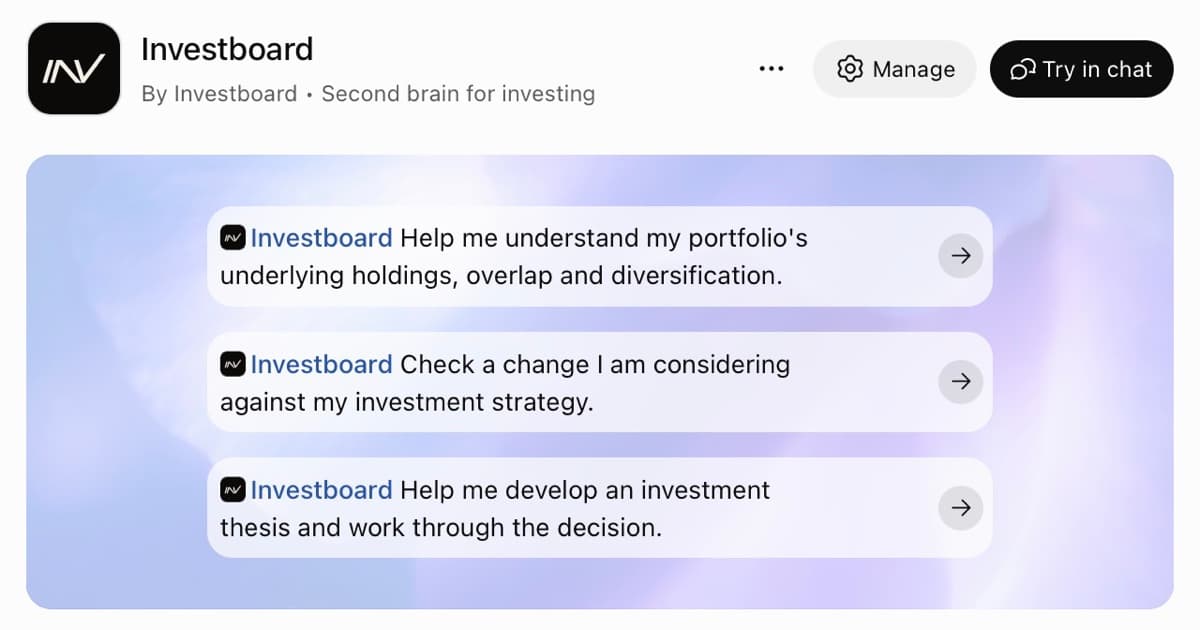
You can install the Investboard plugin directly in ChatGPT.
That is one of several ways to use the connection in Claude, ChatGPT, or another compatible AI app. You can explore what you own, understand changes in your wealth, replay historical crises, and prepare a portfolio review for your own approval. The conversation can follow your question from the first explanation to a saved record.
Start with the holdings you have
“Here are my funds and their weights. Where do they overlap?”
You can begin with holdings you supply in the conversation. The plugin can analyze their allocation, look through equity funds to the companies inside them, identify overlapping holdings, and describe concentration, sectors, countries, currencies, and fund costs where reference data is available. It can also replay historical crisis scenarios over that submitted mix.
For questions about your saved portfolio, connect your Investboard account and grant the relevant access. The agent can then read your imported holdings and saved strategy without asking you to paste them into each conversation. Account access remains subject to the permissions you grant and the features included in your plan.
See your investments across accounts
“Give me an overview of everything I own and where my biggest risks are.”
A holding can look small in one account and become a substantial exposure when it appears across several accounts and inside your funds. The connected portfolio view brings those imported accounts together.
You can ask where your largest company exposures come from, which funds hold the same companies, or how your investments are distributed across asset classes and markets. Follow up with “Which of my holdings have moved together most?” to examine measured historical correlations.
Shared holdings and historical correlation answer different questions. One describes what funds own; the other describes how investments moved over a measured period. The answer should keep those distinctions, the dates, and any gaps in coverage visible.
Understand how your wealth changed
“How has my wealth developed over the last twelve months, and what drove it?”
The plugin can retrieve Investboard’s performance calculation across your owned accounts. It separates money you contributed or withdrew from the investment result and explains the available evidence on holdings, costs, and currency effects.
You can then narrow the question: “Which three positions contributed most?” or “How much of the change came from exchange rates?”
The available history determines how far the explanation can go. If only three months can be measured, the answer should name that window. If some holdings lack usable price history or recorded costs, those gaps remain part of the explanation. A missing cost figure does not establish that an investment was free.
Compare what to do with a new contribution
“I can invest €500 a month. How can I distribute it without selling anything?”
The agent can compare the contribution with your signed strategy using Investboard’s own calculation. The alternatives cover keeping the portfolio as it is, investing new money, investing only part of the amount, and rebalancing through sales.
You can see how each alternative affects your allocation, remaining distance from your targets, cash reserve, and available cost information. Your strategy may require some money to remain in cash, so naming an amount does not guarantee that the calculation will allocate all of it to investments.
You can also ask about selling costs. Tax estimates are available only where the calculation proposes and evaluates a sale with sufficient inputs. When no sale is proposed, a displayed zero is not an estimate that selling would be tax free.
The comparison helps you assess the choices against your own plan. It saves no investment instruction and places no order.
Check a proposed change against your strategy
“I want to invest €5,000 of new money in a world equity ETF. Does that fit my strategy?”
A strategy check evaluates the proposed change against the applicable rules in your mandate. It can show the current and projected state of a rule, identify a breach or cooling-off requirement, and explain when the evidence is insufficient.
The source of the money matters. Adding money from outside the portfolio changes the calculation differently from using existing cash or selling another holding. State that source when you know it. If the agent assumes new money because no source was given, it should disclose the assumption and offer to check the other basis.
Be specific about the investment when the question requires it. An asset-class check can assess the equity allocation, but it cannot establish the underlying company exposures of an unnamed fund.
Each check creates a saved entry in your Investboard history. You decide what to do with the result.
Replay a historical crisis over your portfolio
“What would a crisis like 2008 do to my portfolio today?”
The agent can select a historical scenario, start a stress test over your current holdings, and read the result when the calculation finishes. The run also appears in your Investboard stress-test history.
Follow with “How does that compare with the Covid crash?” to examine another scenario. The explanation can show the hypothetical change in value, which positions drive it, which parts cushion it, and the recovery period reported by the model.
The method matters as much as the headline loss. Some positions can use their own historical prices; others require sector or asset-class proxies. Positions the scenario cannot model are identified as exclusions. Currency and hedging effects may also be incomplete.
A crisis replay helps you examine the sensitivity of today’s portfolio. Its losses and recovery periods describe the scenario, not a prediction of your future experience.
Keep a record of your decisions
“I decided to wait. Record that against this check.”
After a check, you can ask the agent to record whether you proceeded, abandoned the change, or deferred it, with an optional note in your own words. The decision is final for that check, so be clear about what you are asking it to retain.
That record captures what you reported. It does not send an order or independently verify a purchase at your broker.
You can also return to your decision journal and recorded investment theses to recall the reasoning you wrote down. Later, ask “Did my past decisions help?” The plugin can retrieve Investboard’s comparison of recorded decisions with leaving the portfolio unchanged, where the required evidence exists.
A recorded intention, an observed transaction, and a measured outcome remain distinct. When the history cannot support a comparison, the useful answer is an explanation of what is missing.
Prepare and complete a portfolio review
“It is time for my quarterly review. What changed since the last one?”
The plugin connects the review conversation to the review you retain in Investboard:
-
Read the changes. Examine the comparison with your last approved review, including available value changes, funding, investment result, corrected records, and mandate changes. A first review has no earlier approved comparison point.
-
Provide your reasoning. State why you are keeping or reconsidering the strategy, what you expect to observe, what would change your view, and when you want to review it again.
-
Open the prepared review. The agent returns a link to the wording and comparison in Investboard. You inspect it and choose whether to save a draft or complete the review.
-
Check what was retained. Ask whether it is still prepared, saved as a draft, or completed. The answer comes from the saved state and receipts.
Preparation alone completes nothing. Only your approval in Investboard completes the review and establishes the comparison point for the next one. A saved draft remains a draft. Prepared reviews expire after one day.
Continue in a new conversation
“Show me the 2008 stress test we ran earlier.”
You can retrieve a recent retained stress test and its result without carrying a technical identifier from the original conversation. You can also ask which recent tests are available.
For reviews, a new conversation through the same connected agent can retrieve its latest preparation and check whether you approved it. That lookup is limited to the preparing connection; it does not expose a preparation made through another agent.
The continuity comes from records retained in Investboard. The agent does not need to claim that it remembers another chat.
Choose a question to begin
Connect Investboard, grant the access needed for your question, and start with something you already want to understand:
-
“Where am I most concentrated?”
-
“Why did my portfolio value change?”
-
“Compare using my next contribution with selling.”
-
“Does this proposed purchase fit my strategy?”
-
“Prepare my quarterly review.”
Answers include links to the corresponding pages in Investboard, so you can inspect the evidence and continue there. Some work has limits: agents currently share an allowance of eight new stress tests and prepared reviews per investor per day. Reading retained results does not use that allowance.
You remain responsible for investment decisions and approval. Investboard provides the calculations and records behind the conversation; it does not place or transmit orders.
Common questions
What can the Investboard plugin do in ChatGPT?
The Investboard plugin can analyze supplied holdings, read authorized portfolio data, explain measured performance, compare contributions and replay historical crises. It can also check a proposed change, record your stated decision and prepare a portfolio review. Results depend on available data, permissions and plan access.
How do I install the Investboard plugin in ChatGPT?
Open the published Investboard listing in ChatGPT’s plugin directory and choose Install plugin. Start a conversation with Investboard. For saved account data, connect your Investboard account and review the requested permissions. Your ChatGPT plan and workspace settings determine plugin availability.
Can ChatGPT analyze investments across several accounts?
With the relevant access, Investboard’s portfolio tools bring your imported accounts together. They can show asset allocation, underlying equity-fund holdings, shared positions, concentration and measured historical correlations. Dates, coverage and missing data remain part of the result; unimported accounts are not included.
Can the plugin buy or sell investments for me?
No. Investboard does not place or transmit orders. A strategy check saves a record of the proposed change and its assessment. Recording that you proceeded captures your statement; it does not independently prove that a trade occurred at your broker.
Can I run a portfolio stress test through ChatGPT?
Yes. The connected agent can select a historical scenario, start a test and read the result. It can compare crises such as 2008 and the Covid crash. Results may use price histories or sector and asset-class proxies; they are hypothetical replays, not forecasts. New tests share the daily work allowance with prepared reviews.
Does preparing a portfolio review complete it?
No. The agent prepares your wording and returns a link. You inspect it in Investboard and choose whether to save a draft or complete the review. Only your approval completes it and establishes the next comparison point. Preparations expire after one day.
Can I retrieve a stress test or review in a new chat?
You can retrieve recent retained stress tests without an identifier from the original chat. A new conversation through the same connected agent can also recover its latest prepared review and read the saved state. It cannot retrieve a preparation made through another agent’s connection.
Sources
- Investboard: published ChatGPT plugin · OpenAI · Accessed: 2026-11-13
- Investboard AI Toolkit: account access and installation · Investboard · Accessed: 2026-11-13